.png)
For banks and financial institutions, the so-called SaaS apocalypse should not feel like a threat. It should feel like a correction.
For more than a decade, financial institutions have been pushed toward point solutions for every operational gap. Need a new workflow? Buy another tool. Need a better approval path? Submit a ticket and wait. Need a customer portal, a credit memo process, a rules engine, or a new data view? Add another vendor, another integration, and another layer of complexity.
The result is not transformation. It is software sprawl. Teams are surrounded by technology but still constrained by systems that are difficult to change, hard to connect, and too often built around someone else’s idea of how the business should work.
That is the real problem Platform0 was built to solve. Banks do not need more disconnected software. They need a faster, safe way to turn institutional knowledge into working applications, workflows, portals, and processes that reflect how their teams, customers, policies, and data actually operate.
Platform0 is a fully configurable enterprise application platform that helps financial institutions create, refine, and launch custom business software in days or weeks instead of months. It gives organizations the ability to build around their own workflows, business logic, data structures, and roles without forcing a rip-and-replace project or another long development queue.
Why financial institutions have outgrown the old SaaS model
Traditional enterprise software was supposed to make institutions more efficient. In many cases, it did the opposite. It forced banks to shape their processes around fixed product assumptions, then rely on support tickets, implementation timelines, vendor roadmaps, and custom development cycles whenever the business needed something different.
That model is especially difficult in financial services. Every institution has its own credit policies, approval paths, reporting requirements, risk controls, customer expectations, and team structure. Those differences are the operating model, not edge cases.
When technology cannot adapt to those differences, teams compensate with manual workarounds, spreadsheets, one-off processes, and additional tools. Over time, the stack becomes heavier, but the organization does not necessarily become more capable.
Platform0 changes the starting point. Instead of asking a bank to conform to the software, it gives the institution a way to configure software around the way work actually gets done. Teams can create workflows, custom credit memos, underwriting and decisioning processes, role-based views, and operational tools using real business context, then refine them as needs change.
A platform that works with the systems banks already have
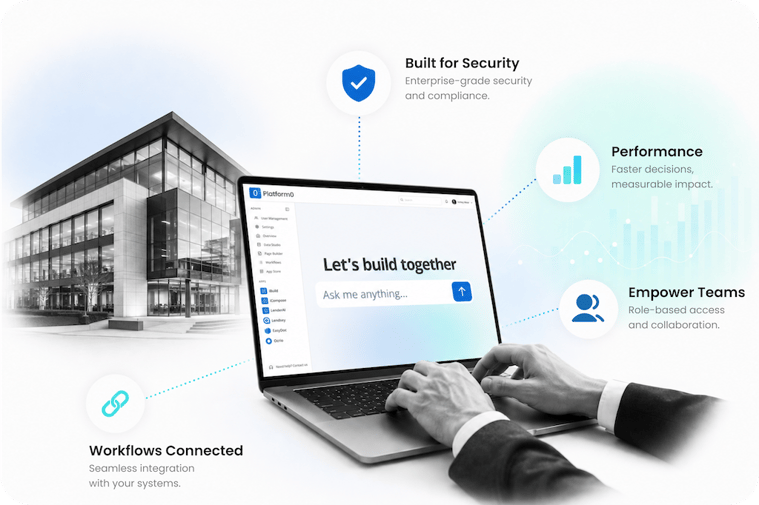
Modernization does not have to mean abandoning years of existing technology investment. Platform0 is designed to operate as a connective layer across an institution’s current environment, helping fill workflow and application gaps without turning every improvement into a full migration project.
That distinction matters. Banks need speed, but they also need governance. Platform0 brings configurable workflows, rules engines, permissions, data structures, document automation, application modules, and AI-powered software design tools into a secure environment built for regulated organizations.
It also keeps implementation flexible. Platform0 can support internal teams and trusted third-party implementation partners working together to deliver the right outcome. The goal is not to cut partners out of the process but to remove the bottlenecks that keep good ideas from becoming usable software.
With Platform0, the people closest to the operational challenge can participate more directly in the solution. Business users can describe what they need in plain language. Domain experts can test and refine live workflows. Technical teams can maintain the control and visibility they need. The result is a more practical path from idea to execution.
The value is not just consolidation. It is capability expansion.
Reducing software sprawl is useful, but it is not the main point. The bigger opportunity is what banks can do when software development cycles stop dictating the pace of business change.
A regional bank that needs to improve onboarding should not have to wait months to test a better process. A lending team that wants to bring more of its small business lending workflow in-house should not have to choose between speed and control. An operations team that needs a new approval path, portal, or reporting view should not have to turn every change into a major project.
Platform0 compresses that cycle. It gives institutions a way to expand what their teams can build, test, and deploy while still operating within the guardrails required in financial services. AI agents and software design tools can help handle repetitive work and orchestrate behind-the-scenes processes, but the platform is grounded in governance, permissions, role-specific views, and real operational data.
The time gains are material. iBusiness.ai has seen product release timelines reduced by up to 90 percent, shortening the path from idea to usable software. That means teams can spend less time translating business needs into tickets and more time improving the processes that affect customers, employees, and revenue.
What the post-SaaS bank looks like
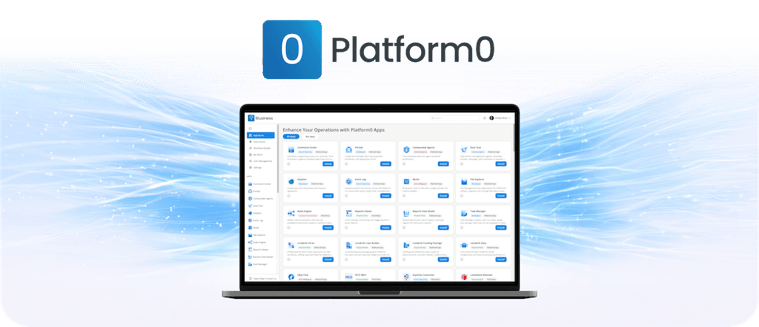
The next generation of banking technology will not be defined by who has the largest stack. It will be defined by who can adapt fastest without losing control.
That is why Platform0 is more than another application in the stack. It is the foundation for iBusiness.ai’s next generation of banking applications, including iBuild for AI-powered software creation, EasyDoc for document generation and approvals, Sheets for structured data work, and the fully configurable version of LenderAI.
Together, those capabilities point to a different operating model: one where banks can build around their own data, rules, workflows, and teams; where business users and technical teams collaborate on live solutions; and where the institution does not have to wait on a vendor roadmap to move forward.
The SaaS apocalypse is not about abandoning software. It is about ending the era where software dependency determined how quickly a bank could act.
The institutions that win in the next decade will not be the ones with the most tools but the ones that can turn ideas into governed, usable capabilities before the opportunity passes. Platform0 gives them the operating layer to do it.
Learn more about Platform0 at ibusiness.ai/platform0.